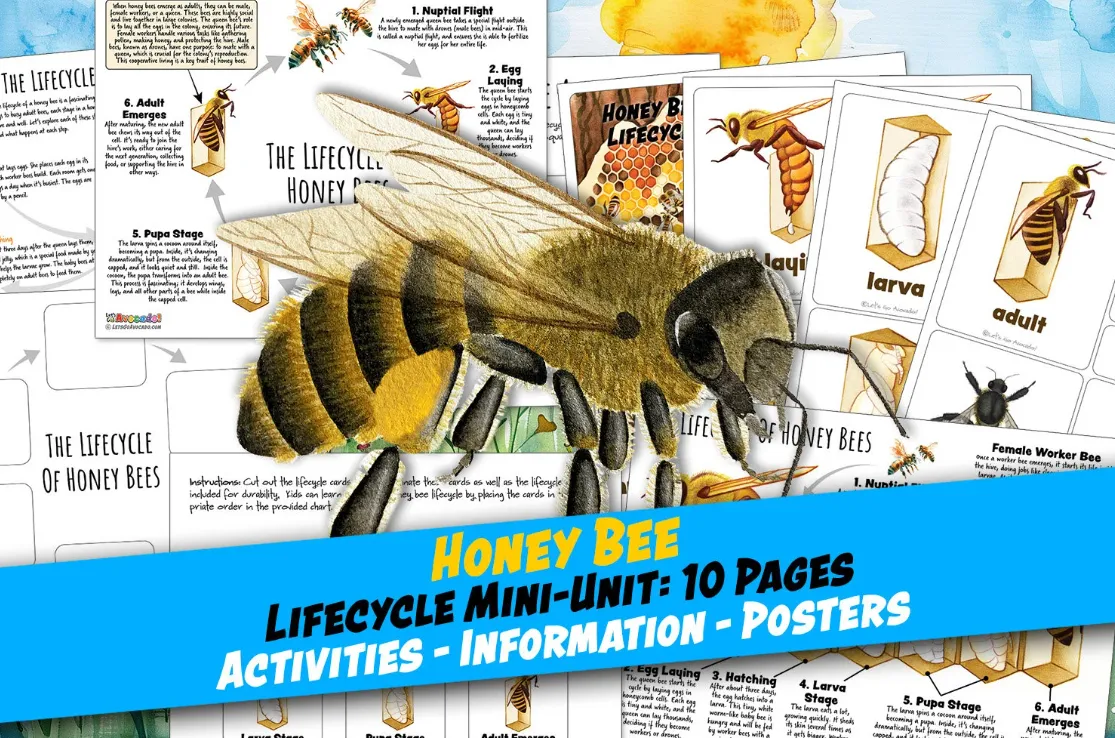
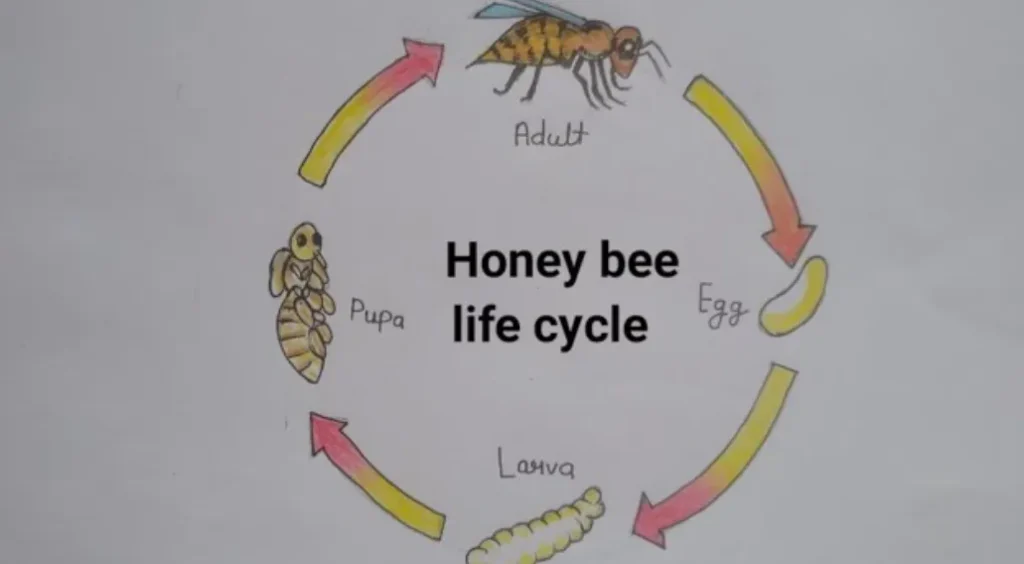
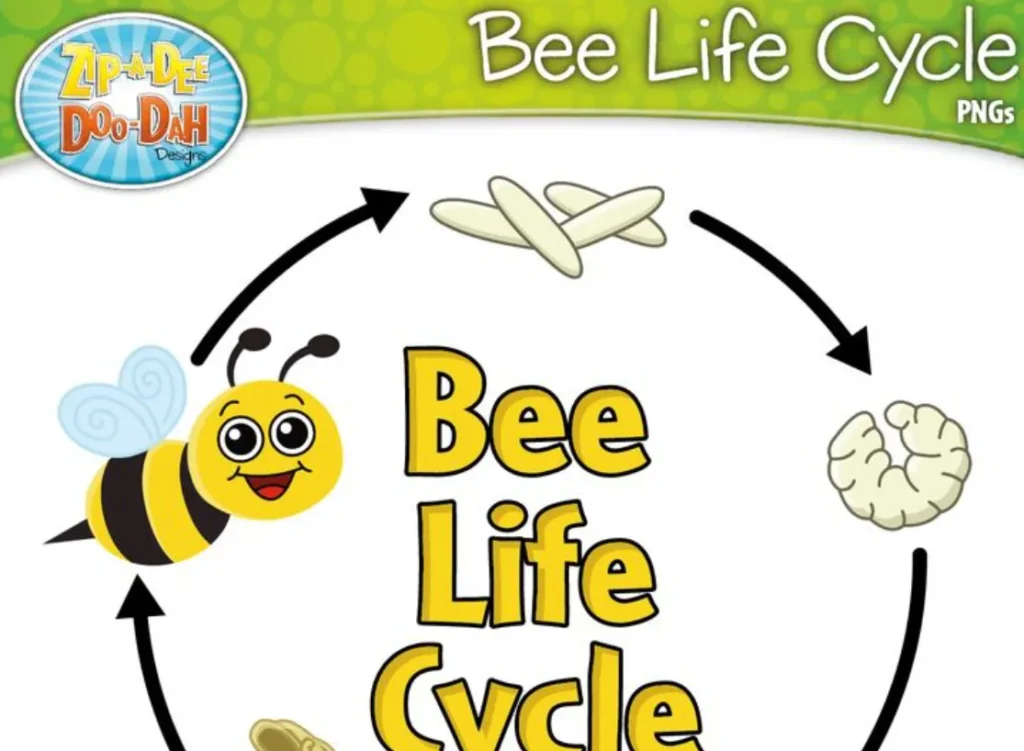
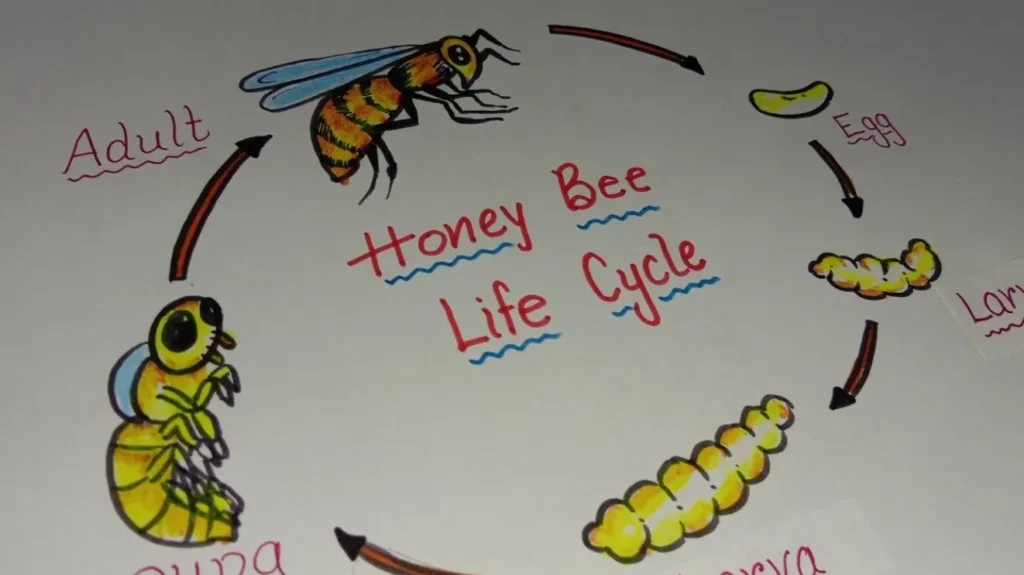
The honey bee’s life cycle is one of the most organized and important natural processes in the insect world. A honey bee does not grow like a mammal or a bird. Instead, it undergoes complete metamorphosis, meaning its body passes through four distinct stages: egg, larva, pupa, and adult.
The most common species people mean when they say “honey bee” is the western honey bee, Apis mellifera. This species lives in a highly structured colony with one reproductive queen honey bee, thousands of female worker bees, and seasonal male bees called drones.
Each caste has a different development timeline. A queen usually becomes an adult in about 16 days, a worker in about 21 days, and a drone in about 24 days. These timelines can shift slightly due to temperature, nutrition, colony strength, and hive conditions.
Understanding the honey bee’s life cycle helps beekeepers, gardeners, students, and nature lovers protect bees more effectively. It also explains why a healthy honey bee hive depends on good food, clean water, strong brood care, and protection from pests such as Varroa mites.
Quick Answers: Most Common Questions
Q: What are the 4 stages in the life cycle of the honey bee?
A: The four stages are egg, larva, pupa, and adult. This is called complete metamorphosis.
Q: How long does it take for a honey bee to become an adult?
A: It depends on caste. A queen honey bee develops in about 16 days, a worker in about 21 days, and a drone in about 24 days.
Q: Who lays eggs in a honey bee hive?
A: The queen honey bee lays almost all eggs in a healthy colony. Fertilized eggs become female bees, while unfertilized eggs become male drones.
Quick Life Cycle Table
| Stage | What Happens | Usual Time | Key Detail |
| Egg | Queen lays one egg in a wax cell | About 3 days | Fertilized eggs become females; unfertilized eggs become drones |
| Larva | Nurse bees feed the young bees | About 5.5–6.5 days | Diet helps decide whether a female becomes a worker or a queen |
| Pupa | Body changes inside a capped cell | About 7.5–14.5 days | Wings, legs, eyes, and adult body form |
| Adult | The bee emerges and begins its colony role | Varies | Queen, worker, and drone have different jobs and lifespans |
Important Things That You Need To Know
The term “honey bee” usually refers to the western honey bee, Apis mellifera, the species most commonly managed by beekeepers for honey, wax, and pollination. This species is famous for living in a complex colony system and producing surplus honey that humans can carefully harvest.
A honey bee hive is not just a box or nest. It is a living community where the queen lays eggs, workers raise young bees, drones prepare for mating, and foragers collect nectar, pollen, water, and plant resins. In managed beekeeping, hives often use removable frames so beekeepers can inspect brood, honey stores, and bee health without destroying the colony.
Many people search for bumblebee vs. honeybee because the two insects look similar at first glance. Bumble bees are usually rounder, fuzzier, and live in smaller colonies. Honey bees are slimmer, store larger amounts of honey, and can maintain perennial colonies that survive across seasons.
The queen honey bee is the reproductive center of the colony, but she does not “rule” like a human monarch. Her main biological roles are egg-laying and chemical communication via pheromones.
Some searches also mention honey bee stamps. These are not part of bee biology, but postal stamps featuring honey bees are often used to celebrate pollinators, agriculture, nature conservation, and World Bee Day themes.
For beginners, honey bee supplies usually include a hive, frames, a veil, gloves, a smoker, a hive tool, a feeder, and bee-safe management materials. Good supplies support colony care, but they cannot replace good knowledge of bee biology.
The History Of Their Scientific Naming, Evolution, and Their Origin
Scientific Name: Apis mellifera
The western honey bee is scientifically named Apis mellifera. The genus name Apis means bee, while mellifera is commonly interpreted as honey-bearing or honey-carrying.
This name was formally linked to the species by Carl Linnaeus in 1758, during the early development of modern biological classification. Today, Apis mellifera remains the accepted scientific name for the western honey bee.
Evolutionary Background
Honey bees belong to the order Hymenoptera, the same broad insect group that includes ants, wasps, and many other bees. Their evolution is closely tied to flowering plants because bees and flowers developed a powerful relationship based on nectar, pollen, and pollination.
The western honey bee became especially successful because it evolved eusocial behavior. This means it has cooperative brood care, overlapping generations, and a division of labor between queen, worker, and drone bees.
Origin And Spread
The natural range of Apis mellifera extends across Europe, Africa, and the Middle East. Over centuries, humans moved this bee around the world for honey production and crop pollination.
Today, the western honey bee is present on every continent except Antarctica. It is one of the most studied insects in agriculture, ecology, genetics, and animal behavior.
Their Reproductive Process, Giving Birth And Rising Their Children
Honey Bees Do Not Give Birth
A honey bee does not give birth to live young. Instead, the queen honey bee lays eggs inside prepared wax cells. Each egg stands upright at first, then gradually tilts as it develops.
In a strong colony, workers clean and prepare brood cells before the queen lays. The queen checks the cell size and may lay a fertilized or unfertilized egg, depending on colony needs and cell type.
Fertilized And Unfertilized Eggs
A fertilized egg becomes a female bee. Depending on feeding and cell conditions, that female may develop into a worker bee or a new queen honey bee.
An unfertilized egg becomes a male drone. Drones do not gather nectar, build a comb, or defend the hive. Their main biological role is mating with a virgin queen from another colony.
Mating And Egg Production
A young queen usually takes mating flights early in adult life. She mates with multiple drones in the air and stores sperm in a special organ called the spermatheca.
After mating, she can lay fertilized eggs for a long period. In peak season, a productive queen may lay hundreds or even more than a thousand eggs per day when food, space, and worker population are strong.
Raising The Young
Worker bees raise the young. Young adult workers act as nurse bees, feeding larvae with glandular secretions, royal jelly, pollen-based food, and nectar-based food.
The colony raises its children collectively. No single worker owns the brood. The entire honey bee hive functions as one family unit, often described as a superorganism.
Stages of the Life Cycle of the Honey Bee
Stage 1: Egg
The first stage in the life cycle of the honey bee begins when the queen lays a tiny white egg in a wax cell. The egg is very small and often compared to a grain of rice.
The egg stage usually lasts about 3 days. During this time, the developing bee remains inside the egg until it hatches into a larva. The egg’s future depends on whether it is fertilized and what kind of cell it is placed in.
Stage 2: Larva
After hatching, the bee enters the larval stage. The larva looks like a soft, white, curled grub. It has no wings, legs, or adult bee features yet.
Nurse bees feed larvae many times each day. All young larvae receive rich food at first, but queen-destined larvae continue receiving royal jelly in special queen cells. Worker and drone larvae later receive a different mix that includes pollen and nectar-based food.
This feeding period is one of the most important parts of honey bee development.
Stage 3: Pupa
When the larva is ready, worker bees cap the cell with wax. Inside the sealed cell, the larva undergoes pupation.
During the pupal stage, the bee’s adult body forms. Wings, legs, eyes, antennae, hairs, and mouthparts develop. The bee also changes color as its body matures.
Queens have the shortest pupal period, drones the longest, and workers are in between.
Stage 4: Adult
The adult bee chews through the wax capping and emerges from the cell. Its role depends on caste.
A new worker starts with indoor tasks such as cleaning cells and feeding larvae. Later, she may build a comb, guard the hive, process nectar, and finally forage outside. A queen prepares for mating and egg-laying. A drone matures for mating flights.
This adult stage completes the visible life cycle of the honey bee, but it also begins the bee’s role in colony survival.
Their Main Diet, Food Sources, And Collection Process Explained
The main diet of a honey bee is based on nectar, pollen, water, and stored honey. Each food source has a different purpose inside the colony.
Nectar And Honey
Nectar is a sugary liquid produced by flowers. Forager bees collect nectar using their long tongue-like mouthpart called a proboscis. They store it in a special internal pouch often called the honey stomach.
Back in the hive, nectar is passed to house bees. These workers process it with enzymes, reducing the moisture until it becomes honey. Honey is the colony’s main energy source, especially during winter or rainy periods.
Pollen And Bee Bread
Pollen provides protein, fats, vitamins, and minerals. Worker bees collect pollen on their body hairs and pack it into pollen baskets on their hind legs.
Inside the hive, pollen, nectar, and microbial activity combine to form bee bread. This is essential for feeding larvae and supporting young nurse bees.
Water And Minerals
Honey bees also collect water. Water helps cool the hive, dilute honey, and maintain brood nest conditions.
Bees may also gather minerals from damp soil or natural water sources. Clean water near the hive reduces the need for risky flights to polluted or treated areas.
Collection And Communication
Foragers do not search randomly. Successful bees return to the hive and may perform a waggle dance to communicate direction and distance to food sources.
This collection system makes the honey bee hive highly efficient. One colony can visit thousands or millions of flowers during a productive season.
How Long Does A Honey Bee Live
The lifespan of a honey bee depends on caste, season, workload, nutrition, pests, diseases, and environment. A queen, a worker, and a drone are all honey bees, but they do not live the same length of time.
- Worker bees in spring and summer usually live about 5 to 7 weeks. Their lives are short because they work intensely. They clean cells, feed larvae, build wax, process nectar, guard the entrance, and finally forage outside.
- Winter worker bees can live much longer, often several months. They are physiologically different from short-lived summer workers. Their job is to keep the colony alive through cold periods, cluster around the queen, and conserve stored food.
- A queen honey bee commonly lives 1 to 2 years in managed hives, although some queens can live longer. Beekeepers often replace queens when egg-laying declines, not always because the queen has died.
- Drone bees often live from a few weeks to a few months. If a drone successfully mates with a queen, it dies soon after mating. If he does not mate, he may be expelled from the hive before winter because he consumes food but does not help with winter survival.
- Foraging is dangerous for worker bees. Older workers face weather, predators, pesticides, exhaustion, and navigation risks. Many do not die inside the hive.
- Nutrition strongly affects lifespan. Colonies with diverse pollen sources tend to raise healthier brood and stronger adult bees.
- Parasites and disease reduce survival. The Varroa mite is one of the most serious threats because it weakens bees and spreads viruses.
- Temperature matters. Brood must be kept warm and stable. Severe heat, cold, or poor ventilation can harm developing bees.
- A single bee’s lifespan is short, but the colony can survive for years if it continuously raises new generations.
- The real survival unit is the colony. A strong colony replaces aging bees with new adults before the worker population collapses.
Honey Bee Lifespan in the Wild vs. in Captivity
Lifespan In The Wild
Wild or feral honey bee colonies often live in tree cavities, wall spaces, cliffs, or other protected hollows. Their individual bees follow the same biological lifespan pattern as managed bees, but wild colonies face more uncontrolled threats.
They must find their own food, defend against predators, manage temperature, survive drought, and fight pests without beekeeper support. In many regions, untreated colonies struggle because of Varroa mites, viruses, poor forage, and habitat loss.
Wild colonies that survive often have strong genetics, good nesting sites, and access to diverse flowers.
Lifespan In Managed Hives
Managed hives are sometimes described as captivity, but honey bees are not confined like caged animals. They fly freely to collect food and return to the hive.
In a managed honey bee hive, beekeepers may provide protective equipment, extra food during shortages, hive inspections, mite control, queen replacement, and shelter from extreme conditions.
These practices can improve colony survival when done responsibly. However, poor management can also harm bees through stress, overcrowding, chemical misuse, or frequent colony moves.
Main Difference
The biggest difference is not the body lifespan of each bee. It is the colony’s chance of survival. Managed colonies may receive help, while wild colonies rely fully on natural resilience.
Importance of the Honey Bee In This Ecosystem
Pollination And Food Production
The honey bee is one of the world’s best-known pollinators. As workers visit flowers for nectar and pollen, they transfer pollen grains between flowers. This helps many plants produce fruits, nuts, and seeds.
Honey bees are especially important in agriculture because managed colonies can be moved to farms and orchards during bloom periods. Crops such as almonds, apples, berries, melons, cucumbers, and many seed crops benefit from pollination.
Biodiversity Support
Honey bees are not the only pollinators, and they should not replace native bees. However, they still contribute to plant reproduction in many ecosystems.
A healthy landscape needs both managed honey bees and wild pollinators such as bumble bees, solitary bees, butterflies, flies, beetles, birds, and bats.
Economic Value
Honey bees support beekeepers, farmers, gardeners, food businesses, and rural communities. They produce honey, beeswax, propolis, royal jelly, and pollination services.
Their value goes far beyond honey jars. The pollination they provide supports food variety, seed production, and crop quality.
Environmental Indicator
A struggling honey bee hive can signal wider environmental problems. Pesticide exposure, poor nutrition, habitat loss, disease, and climate stress often affect multiple pollinators simultaneously.
Protecting honey bees also encourages better land care, cleaner farming practices, and more pollinator-friendly habitats.
What To Do To Protect Them In Nature And Save The System For The Future
1. Plant More Pollinator-Friendly Flowers
- Grow native flowers, herbs, shrubs, and trees that bloom in different seasons.
- Choose plants that provide nectar and pollen from early spring to late fall.
- Avoid lawns without flowering plants, as they offer little food for pollinators.
2. Reduce Harmful Pesticide Use
- Avoid spraying blooming plants when bees are active.
- Use non-chemical pest control when possible.
- Follow label directions carefully if treatment is necessary.
- Never assume “natural” products are automatically safe for bees.
3. Provide Clean Water
- Place shallow water sources with stones, cork, or floating wood so bees can land safely.
- Keep water fresh and free from chemicals.
- A steady water source keeps bees away from pools, drains, and polluted puddles.
4. Support Responsible Beekeeping
- Learn before buying bees or honey bee supplies.
- Monitor colonies for mites and disease.
- Do not abandon sick hives, because they can spread pests to nearby colonies.
- Choose local beekeeping guidance suited to your climate.
5. Protect Natural Habitat
- Keep wildflower strips, hedgerows, old trees, and natural nesting areas.
- Reduce unnecessary mowing.
- Support farms and communities that build pollinator corridors.
- Protecting habitat helps honey bees, native bees, butterflies, birds, and other wildlife.
Fun & Interesting Facts About Honey Bees
- A honey bee has five eyes: two large compound eyes and three small simple eyes.
- Worker bees have pollen baskets on their hind legs for carrying pollen back to the hive.
- A queen honey bee can lay fertilized and unfertilized eggs. This helps the colony produce workers, queens, or drones as needed.
- Honey bees communicate food location through dances, especially the waggle dance.
- A strong honey bee hive may contain tens of thousands of bees during peak season.
- Drones do not have stingers. Their main role is reproduction.
- Worker bees are female, but most workers do not reproduce in a queenright colony.
- Honey bees make wax from glands on the underside of worker bees’ abdomens.
- The hexagonal shape of honeycomb is strong and space-efficient.
- Honey bees store honey because the colony must survive when flowers are not blooming.
- A bee’s job changes with age. Young workers usually work inside; older workers forage outside.
- Honey bees are not the same as bumble bees. In bumble bee vs honey bee comparisons, bumble bees are usually fuzzier and live in smaller annual colonies.
- The western honey bee is one of the most studied insects in the world.
- Honey bee images often appear on honey bee stamps to promote pollinator awareness and nature education.
- Honey bees are small, but their colony-level teamwork makes them one of nature’s most efficient social insects.
Frequently Asked Questions (FAQs)
Q: What is the life cycle of the honey bee in simple words?
A: The life cycle of the honey bee has four stages: egg, larva, pupa, and adult. The queen lays an egg, it hatches into a larva, changes inside a capped cell as a pupa, and finally emerges as an adult bee.
Q: How many days does a honey bee take to grow?
A: A queen takes about 16 days, a worker about 21 days, and a drone about 24 days to develop from egg to adult.
Q: What does a queen honey bee do in the life cycle?
A: The queen honey bee lays eggs and produces pheromones that help organize the colony. She is the main reproductive female in a healthy hive.
Q: Are honey bees and bumble bees the same?
A: No. In bumble bee vs honey bee comparisons, bumble bees are usually larger and fuzzier, while honey bees are slimmer, live in larger colonies, and store more honey.
Q: What do honey bee larvae eat?
A: Young larvae are fed by nurse bees. Queen larvae receive royal jelly for their development, while worker and drone larvae later receive a mix of glandular food, pollen, and nectar-based food.
Final Word
The honey bee’s life cycle is a precise and powerful example of nature’s organization. From a tiny egg to a working adult, every stage supports the survival of the whole colony. The western honey bee depends on teamwork, clean food sources, healthy brood, and a strong queen-worker system.
Learning about the egg, larva, pupa, and adult stages helps us understand why bees need protection at every level. A damaged habitat, pesticide exposure, poor nutrition, or unchecked mite problem can affect not just one bee, but the entire honey bee hive.
Honey bees matter because they support pollination, food production, biodiversity, and environmental awareness. Protecting them does not require complicated action. Plant flowers, reduce chemical use, provide clean water, protect habitat, and support responsible beekeeping.
Also Read: life cycle lightning bug
About the Author