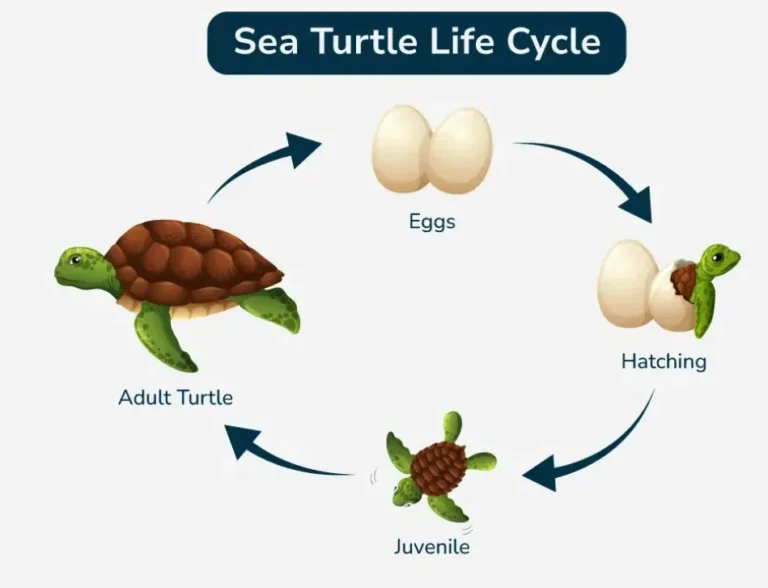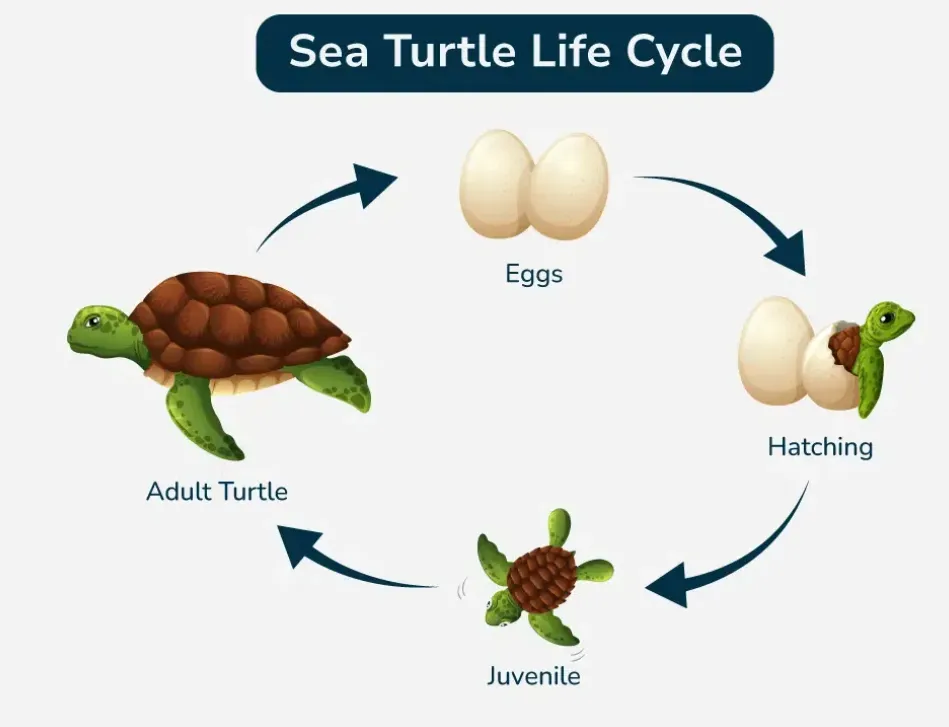
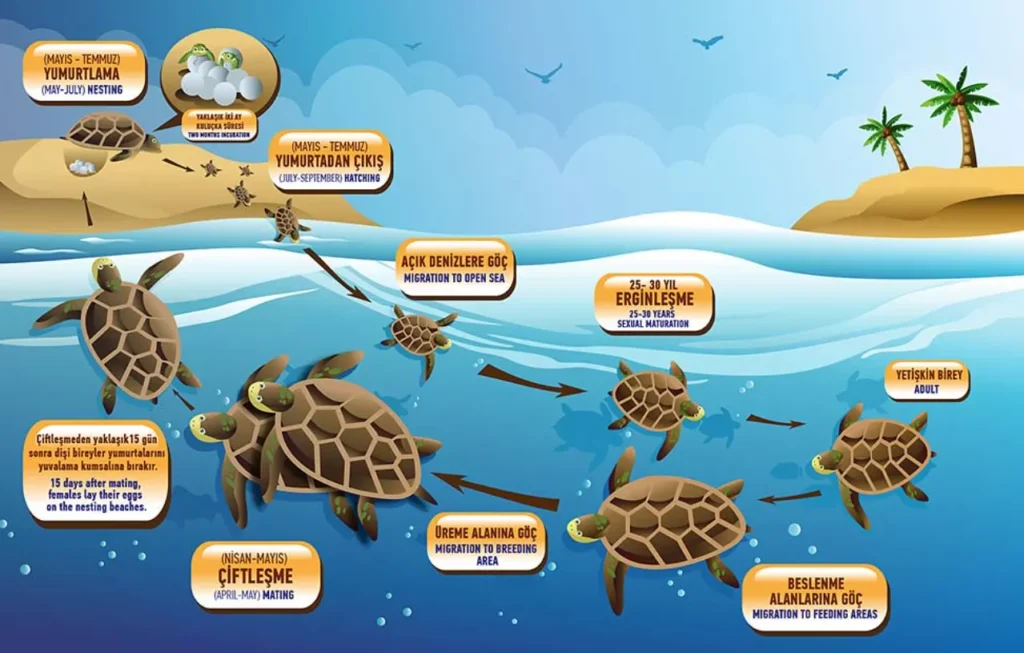
The life cycle of the sea turtle is one of the most fascinating natural journeys in the ocean. A sea turtle begins life as a soft-shelled egg buried in warm beach sand, then becomes a hatchling, moves into the sea, grows through a long juvenile stage, and finally reaches adulthood after many years. Most species spend nearly all their lives in the ocean, but adult females must return to land to lay eggs.
A female sea turtle usually nests at night on sandy beaches, often near the same coastal region where she hatched. After the eggs incubate for roughly six weeks to two months, hatchlings dig upward together and move toward the ocean. Their early years are difficult because predators, currents, pollution, and fishing activity all affect survival. Conservation sources describe this journey as a long cycle from beach to open ocean, then back to nesting beaches when adults are ready to reproduce.
Q: What are the main stages in the life cycle of a sea turtle?
A: The main stages are egg, hatchling, juvenile, and adult.
Q: Do sea turtles give birth to live babies?
A: No. Sea turtles are reptiles, so they lay eggs in nests on sandy beaches.
Q: How long does it take a sea turtle to become an adult?
A: It depends on the species. For example, green sea turtle females may reach maturity at around 25 to 35 years.
Important Things That You Need To Know
The phrase “life cycle of a sea turtle” usually refers to all biological stages from egg to breeding adult. However, different species have different growth rates, diets, habitats, and conservation status. For example, the green sea turtle is famous for its plant-based adult diet, mainly seagrass and algae. This makes it very important for maintaining healthy seagrass beds.
The leatherback sea turtle is very different. It is the largest turtle in the world, has a soft, leathery shell rather than a hard, scaly one, and feeds mostly on jellyfish-like animals. NOAA notes that adult leatherbacks may weigh 750 to 1,000 pounds, grow around 5 to 6 feet, and live 50 years or more, although the exact lifespan is still not fully known.
The hawksbill sea turtle is strongly linked with coral reefs. It has a narrow, bird-like beak that helps it reach sponges in reef crevices. This makes it ecologically valuable because feeding on sponges can help maintain space for corals.
A sea turtle drawing often shows a simple four-stage cycle: eggs on a beach, a small hatchling, a juvenile turtle in the sea, and an adult returning to nest. This is useful for children and educational posters. Still, the real cycle is more complex because young turtles may spend years in open-ocean habitats before moving to coastal feeding areas.
Quick Life Cycle Table
| Stage | Where It Happens | What Happens |
| Egg | Sandy nesting beach | The female lays eggs in a deep sand nest. |
| Hatchling | Beach to shallow sea | Baby turtles hatch, climb out, and rush toward the ocean. |
| Juvenile | Open ocean and coastal waters | Young turtles feed, grow, and avoid predators. |
| Adult | Foraging grounds and nesting beaches | Adults migrate, mate, and females return to lay eggs. |
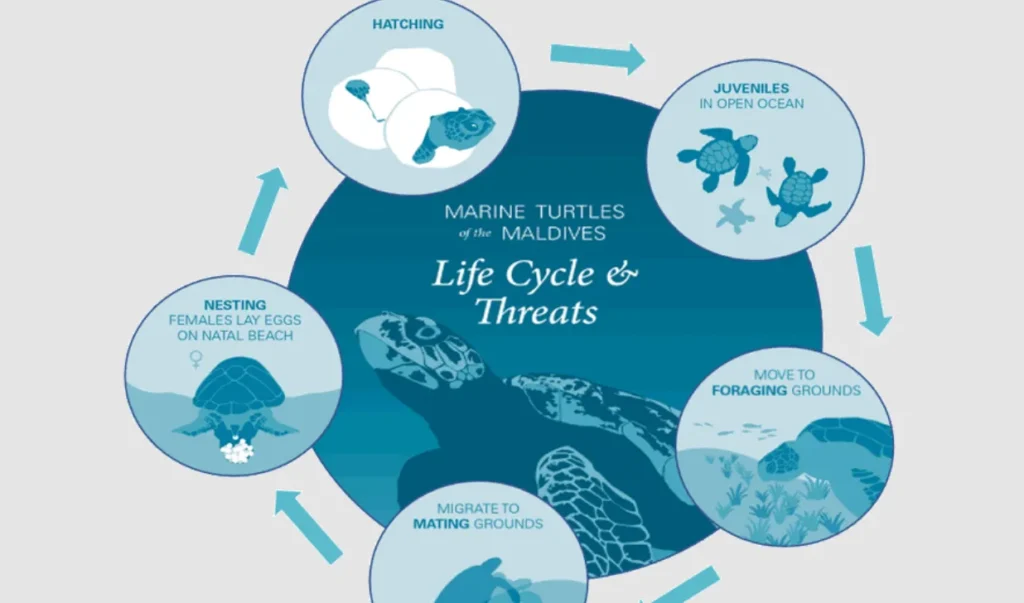
The History of Their Scientific Naming, Evolution, and Origin
Scientific Naming
Modern sea turtles belong mainly to two living families: Cheloniidae and Dermochelyidae. Most hard-shelled sea turtles, including the green sea turtle and hawksbill sea turtle, are in Cheloniidae. The leatherback sea turtle is the only living member of Dermochelyidae.
Evolutionary Background
Sea turtles are ancient marine reptiles. Their ancestors moved from land to sea millions of years ago, gradually developing flippers, streamlined shells, and strong navigation skills. These adaptations helped them survive in the oceans for a very long time.
Origin and Adaptation
Their origin is linked to reptilian evolution, but their modern lifestyle is fully marine, except for nesting. The leatherback sea turtle is especially unique because it has a leathery body covering rather than a hard, bony shell like other sea turtles.
Their Reproductive Process, Giving Birth, and Raising Their Children
Mating and Migration
Adult sea turtles usually migrate between feeding grounds and nesting beaches. Many females return to the general area where they hatched, a behavior known as natal homing. In green sea turtles, adults may migrate every 2 to 5 years from feeding areas to nesting beaches.
Nesting and Egg Laying
Sea turtles do not give birth to live young. The female crawls onto the beach, digs a body pit with her front flippers, then uses her rear flippers to create an egg chamber. Depending on the species, a nest may contain 50 to 200 eggs, and females may lay several clutches in a single nesting season.
Incubation and Hatching
The eggs remain buried in warm sand until the embryos develop. After hatching, the baby turtles work together to move upward through the sand. Once they reach the surface, they head toward the sea as quickly as possible.
Raising Their Children
Sea turtles do not raise their young. After laying and covering the eggs, the mother returns to the ocean. Hatchlings must survive on instinct from the first moment they leave the nest.
Stages of the Life Cycle of the Sea Turtle
Stage 1: Egg Stage
The egg stage begins when a female sea turtle lays eggs in a beach nest. The sand protects the eggs from waves and some predators, while temperature plays an important role in embryo development. Warmer or cooler sand can influence hatchling development and, in many turtle species, sex ratios.
This stage is highly vulnerable. Eggs may be eaten by predators, flooded by storms, damaged by beach traffic, or affected by coastal development.
Stage 2: Hatchling Stage
The hatchling stage begins when baby turtles break out of their eggs using a temporary egg tooth called a caruncle. They slowly move upward through the sand and usually emerge at night.
After reaching the surface, hatchlings move toward the brightest natural horizon, normally moonlight reflecting on the ocean. Artificial lights from buildings can confuse them, leading them to crawl inland rather than toward the sea.
Stage 3: Juvenile Stage
The juvenile stage is long and mysterious. Many young turtles spend years in open-ocean habitats, sometimes drifting with seaweed communities such as Sargassum. This early period is often called the “lost years” because tracking tiny turtles in the ocean is extremely difficult.
As they grow larger, many juveniles move into coastal foraging grounds where food is easier to find.
Stage 4: Adult Stage
The adult stage begins when sea turtles reach sexual maturity. Adults spend most of their lives feeding, migrating, and breeding. Females return to nesting beaches to lay eggs, restarting the cycle.
This stage may last for decades. Some species, such as green sea turtles, can live 70 years or more.
Their Main Diet, Food Sources, And Collection Process Explained
A sea turtle‘s diet depends strongly on its species and life stage. Hatchlings are often more flexible feeders, while adults may become specialized.
Green Sea Turtle Diet
Adult green sea turtles are mostly herbivorous. They feed on seagrass, algae, and seaweed. Their serrated beak helps them scrape algae from rocks and tear marine plants. This feeding behavior helps keep seagrass beds trimmed and productive.
Leatherback Sea Turtle Diet
The leatherback sea turtle mainly eats jellyfish and other soft-bodied animals. Its mouth and throat are adapted to hold slippery prey. Because plastic bags can resemble jellyfish in water, plastic pollution poses a threat to this species.
Hawksbill Sea Turtle Diet
The hawksbill sea turtle is often called a sponge specialist. Its narrow beak allows it to reach into crevices of the coral reef and pull out sponges. This diet connects hawksbills closely with reef health.
How They Collect Food
Sea turtles do not collect food like mammals or birds. They forage by grazing, biting, scraping, crushing, or swallowing prey, depending on the shape of their mouths. Their beaks are adapted to their preferred food sources.
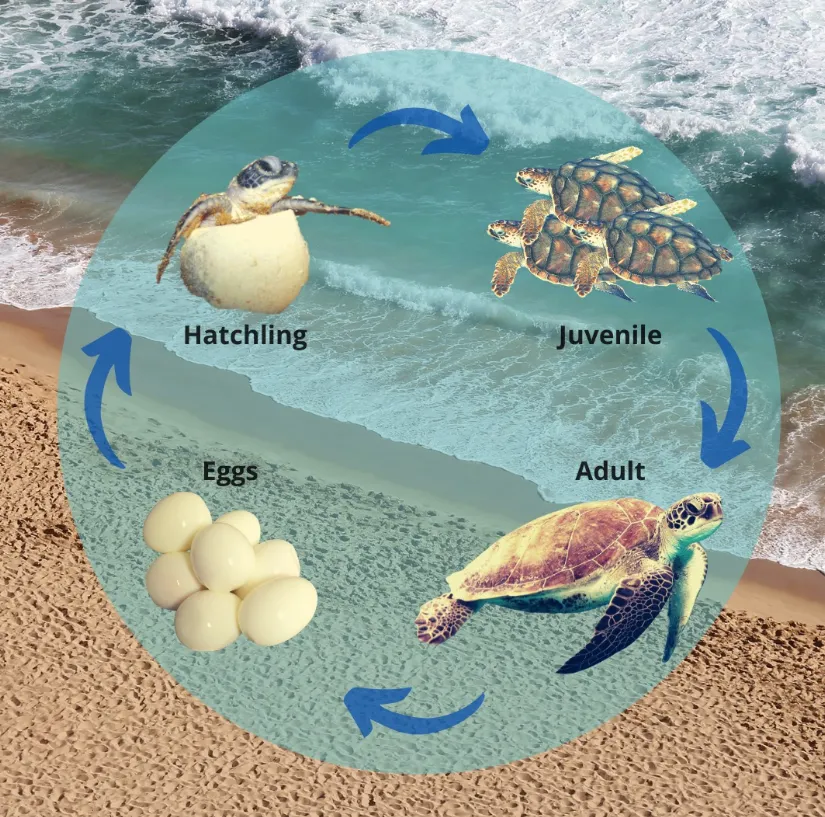
How long does the life cycle of a sea turtle last
The lifespan of a sea turtle is long, but it varies by species, habitat, and survival conditions. Scientists still do not know the exact maximum age for every species because sea turtles spend most of their lives underwater and migrate across large ocean areas.
- Green sea turtle: Can live at least 70 years or more. Females commonly mature at 25 to 35 years old, meaning conservation efforts can take decades to yield full results.
- Leatherback sea turtle: Lifespan is not fully known, but NOAA estimates it may be 50 years or more. Leatherbacks are highly migratory and face heavy risks from fishing gear, pollution, and habitat loss.
- Hawksbill sea turtle: Often lives for several decades, but the exact lifespan depends on population and habitat conditions. Its biggest threats include illegal trade, reef loss, and accidental capture.
- Early survival is very low: Many eggs and hatchlings never reach adulthood because predators, storms, artificial lights, and ocean hazards reduce survival.
- Adult survival matters most: Because sea turtles mature slowly, the loss of adult females has a serious effect on future populations.
- Long life means slow recovery: Even if nesting beaches are protected today, population recovery may take many years because young turtles need decades to mature.
- Human threats shorten lifespan: Bycatch, plastic ingestion, boat strikes, coastal development, and climate change all reduce natural survival chances. NOAA lists bycatch, habitat loss, egg collection, marine debris, and vessel strikes as major threats to sea turtles.
Life Cycle of Sea Turtle Lifespan in the Wild vs. in Captivity
Lifespan in the Wild
In the wild, a sea turtle may live for many decades if it avoids predators and human-caused threats. Wild turtles also follow natural migration routes, choose natural foods, and participate in the full breeding cycle.
However, wildlife is risky. Hatchlings may be eaten before reaching the water. Fish, birds, and sharks can attack juveniles. Adults may be caught in fishing gear, hit by boats, or harmed by plastic pollution.
Lifespan in Captivity
Sea turtles are not typical captive animals. They are large, migratory marine reptiles that require specialized care, large saltwater systems, a correct diet, and veterinary support. Captivity may help injured turtles recover, but it cannot fully replace natural ocean life.
Key Difference
Wild turtles undergo natural migration and reproduction, while captive turtles may be protected from some dangers but are limited in their natural behavior. For conservation, the main goal is not to keep sea turtles in captivity but to protect beaches, oceans, and migration routes.
Importance of the Life Cycle of the Sea Turtle In This Ecosystem
Maintaining Seagrass Beds
The green sea turtle helps maintain healthy seagrass beds by grazing. Proper grazing can encourage fresh growth and support many small marine animals that use seagrass as nursery habitat.
Supporting Coral Reef Balance
The hawksbill sea turtle helps coral reef ecosystems by eating sponges. Without sponge control, some sponges can compete with corals for space. This makes hawksbills important reef managers.
Controlling Jellyfish Populations
The leatherback sea turtle feeds heavily on jellyfish and similar soft-bodied animals. This role helps maintain balance in open-ocean food webs.
Connecting Land and Sea
Sea turtle nesting connects marine nutrients with beach ecosystems. Eggs, shells, and unsuccessful nests can provide nutrients for beach plants and small coastal animals.
Indicator of Ocean Health
Healthy sea turtle populations often suggest healthier beaches, reefs, seagrass beds, and marine food chains. When turtle numbers decline, it may signal wider environmental problems.
What To Do To Protect Them In Nature And Save The System For The Future
Protect Nesting Beaches
- Keep beaches clean and quiet during nesting season.
- Avoid driving on nesting beaches.
- Support protected nesting zones and local monitoring teams.
Reduce Artificial Lighting
- Turn off bright beach lights at night.
- Use turtle-friendly lighting near coastal areas.
- Keep hatchlings from becoming disoriented.
Prevent Plastic Pollution
- Reduce single-use plastic.
- Join beach cleanups.
- Dispose of fishing lines, nets, and plastic bags properly.
Support Safer Fishing Practices
- Encourage turtle-safe fishing gear.
- Support the use of bycatch reduction methods.
- Report trapped or injured turtles to wildlife authorities.
Protect Marine Habitats
- Conserve coral reefs, seagrass beds, and coastal wetlands.
- Avoid damaging reefs while boating or diving.
- Support climate-conscious policies that protect ocean systems.
Fun & Interesting Facts About the Life Cycle of Sea Turtles
- Sea turtles spend most of their lives in the ocean, but females must come ashore to nest.
- A baby sea turtle is called a hatchling.
- The green sea turtle is named for the greenish color of its body fat, not its shell.
- The leatherback sea turtle is the largest living turtle and lacks a hard shell like other sea turtles.
- The hawksbill sea turtle has a sharp, narrow beak that resembles a bird’s beak.
- Some adult sea turtles migrate hundreds or even thousands of miles between feeding and nesting areas.
- Hatchlings often emerge at night to reduce heat stress and predator risk.
- Female sea turtles may lay several nests in one season.
- Many sea turtles return to the same general region where they were born to reproduce.
- A simple sea turtle drawing usually shows four stages, but the real journey includes migration, feeding shifts, and long juvenile development.
Frequently Asked Questions (FAQs)
Q: What is the life cycle of a sea turtle?
A: The life cycle of a sea turtle includes four main stages: egg, hatchling, juvenile, and adult. The cycle begins on a nesting beach and continues through ocean life until adults return to reproduce.
Q: How many eggs does a sea turtle lay?
A: It depends on the species. Some nests may contain 50 to 200 eggs, and females may lay multiple clutches in a single nesting season.
Q: What does a green sea turtle eat?
A: Adult green sea turtles mainly eat seagrass, algae, and seaweed. They are the only sea turtle species that are mostly herbivorous as adults.
Q: Why is the leatherback sea turtle special?
A: The leatherback sea turtle is the largest in the world. It has a leathery body covering instead of a hard shell and feeds mainly on jellyfish-like animals.
Q: Are hawksbill sea turtles endangered?
A: Yes. The hawksbill sea turtle is listed globally as Critically Endangered by the IUCN, mainly due to illegal trade, habitat loss, and other human pressures.
Final Word
The life cycle of the sea turtle is a powerful example of survival, migration, and ocean balance. From tiny eggs hidden in beach sand to adult turtles crossing vast seas, every stage plays a role in nature. The green sea turtle, leatherback sea turtle, and hawksbill sea turtle each show different feeding habits, body structures, and ecological importance.
Their future depends on safe nesting beaches, clean oceans, healthy reefs, and responsible human behavior. Protecting sea turtles is not only about saving one animal group; it is about protecting seagrass beds, coral reefs, marine food webs, and coastal ecosystems. When we reduce plastic pollution, protect beaches, support safer fishing, and respect marine habitats, we help strengthen the entire ocean system for future generations.
Also Read: life cycle of salmon
About the Author