Enterobiasis is a common intestinal parasitic infection caused by the human pinworm (Enterobius vermicularis). When people search for the life cycle of enterobiasis, they are usually trying to understand how pinworm infection starts, how it spreads, how long the worms survive, and why reinfection is so common.
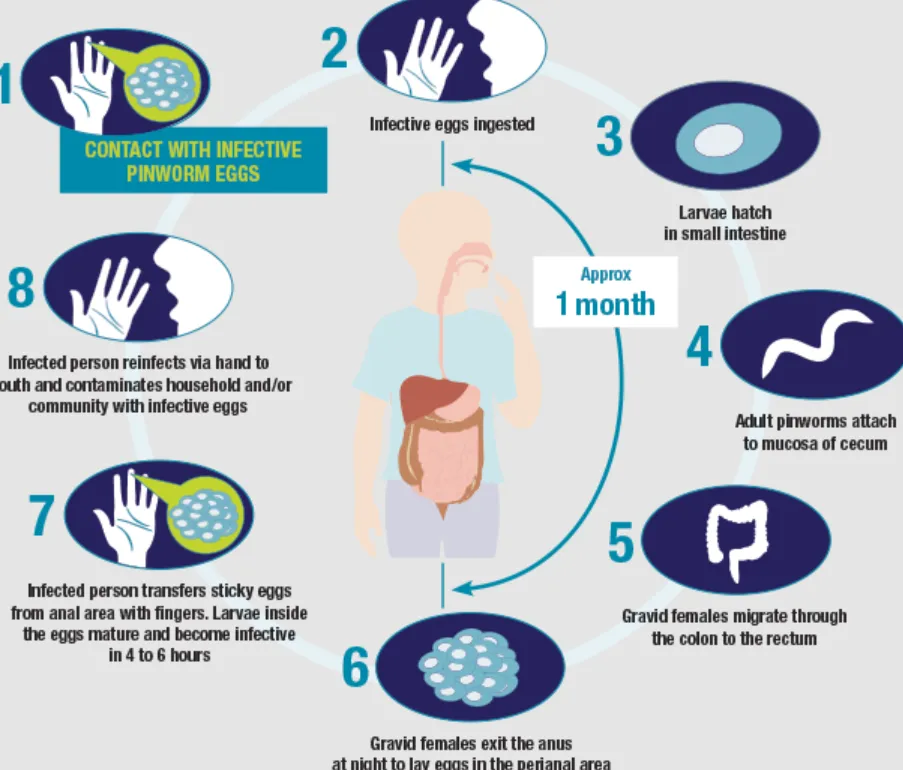
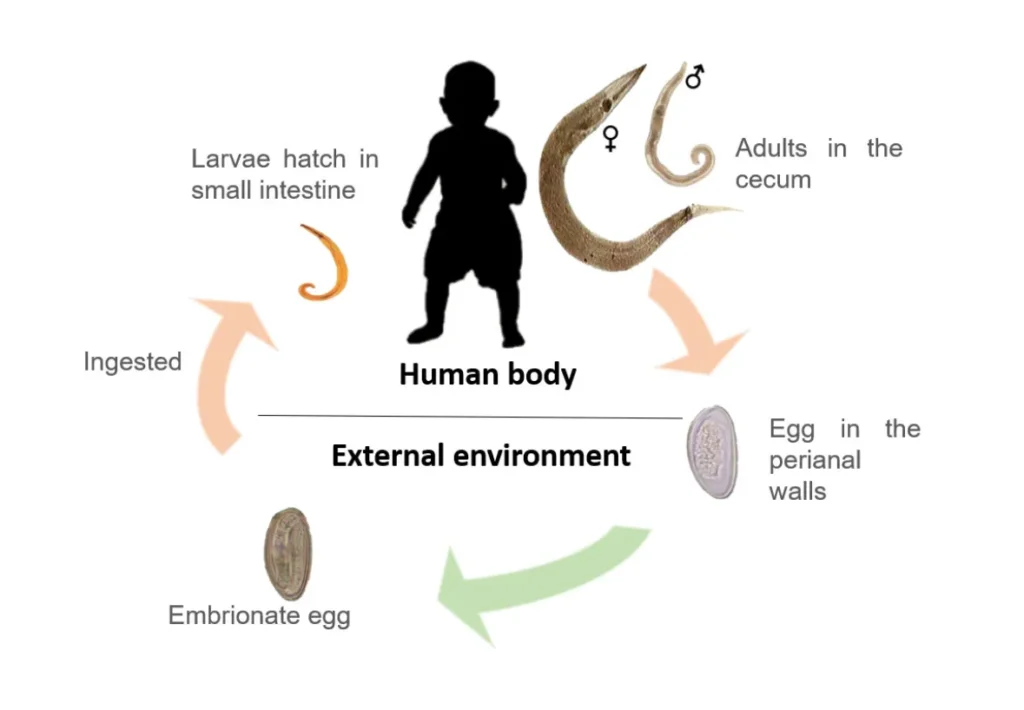
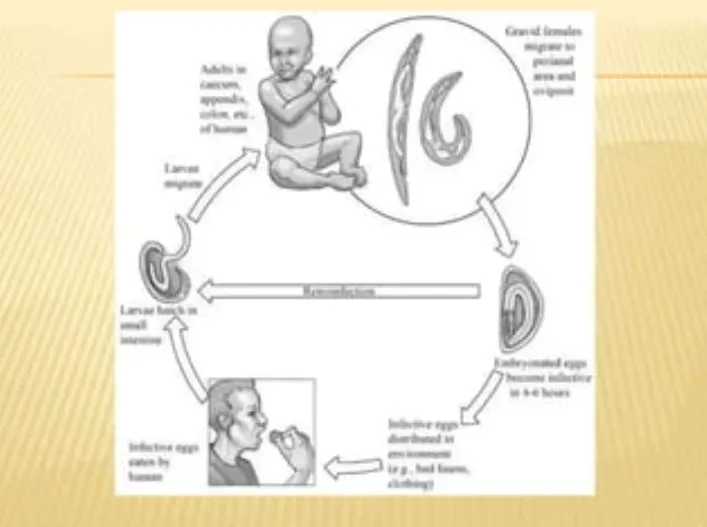
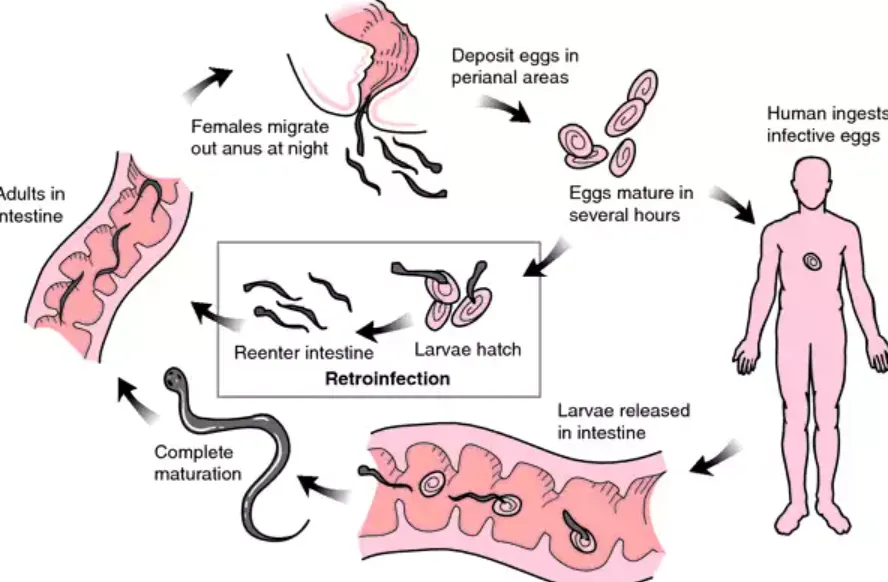
The infection begins when a person accidentally swallows microscopic pinworm eggs. These eggs may be present on contaminated hands, fingernails, clothing, bedding, towels, toys, bathroom surfaces, or food handled with unwashed hands. After the eggs enter the body, larvae hatch in the small intestine and later develop into adult worms in the large intestine, especially around the cecum and colon.
The most recognized sign of enterobiasis symptoms is itching around the anus, often worse at night. This happens because adult female pinworms leave the intestine during sleep and lay eggs on the skin around the anus. Scratching can move eggs to the fingers, under the nails, and then back to the mouth, restarting the infection cycle.
Although enterobiasis can feel uncomfortable, it is usually treatable. Good hygiene, correct diagnosis, household-level treatment, and prevention habits are important because eggs are tiny, sticky, and easily spread in homes, schools, daycare centers, and crowded living environments.
Q: What is enterobiasis?
A: Enterobiasis is a human pinworm infection caused by Enterobius vermicularis, a small white parasitic roundworm that lives mainly in the intestine.
Q: What is the main symptom of enterobiasis?
A: The most common symptom is nighttime itching around the anus. Some people may also have disturbed sleep, restlessness, mild abdominal discomfort, or no symptoms at all.
Q: What is enterobiasis ICD 10?
A: The enterobiasis ICD 10 code is B80, used for pinworm infection, also called oxyuriasis or threadworm infection.
Quick Life Cycle Table
| Life Cycle Point | Easy Explanation |
| Cause | Infection by Enterobius vermicularis, the human pinworm |
| Main Host | Humans are the main natural host |
| Infective Stage | Microscopic eggs that are accidentally swallowed |
| Egg Location | Usually laid around the anal area at night |
| Hatching Site | Larvae hatch in the small intestine |
| Adult Worm Site | Adults mainly live in the colon and cecum |
| Time to Egg-Laying Adult | About one month after swallowing infective eggs |
| Adult Lifespan | Around two months inside the human host |
| Main Spread Route | Hand-to-mouth transfer, contaminated bedding, clothing, toys, and surfaces |
| Common Symptom | Nighttime anal itching |
| Medical Code | ICD-10 B80 |
| Prevention Focus | Handwashing, short nails, morning bathing, washing clothes and bedding |
Important Things That You Need To Know
To understand the life cycle of enterobiasis, it is important to remember that enterobiasis is the disease, while Enterobius vermicularis is the parasite that causes it. The infection spreads mainly through eggs, not through adult worms, and it can spread from one person to another.
One key point is that enterobiasis symptoms can be mild. Some infected people have no obvious symptoms, so the infection may continue spreading quietly within a family, classroom, or childcare setting. When symptoms do appear, anal itching at night is the classic sign.
Another important point is the meaning of enterobiasis. It is not a general stomach worm problem, and it is not the same as every intestinal parasite. It has a very specific life cycle involving egg swallowing, larval hatching, intestinal development into an adult, and nighttime egg-laying around the anus.
The ICD-10 term enterobiasis, ICD-10, is useful for medical documentation. In the ICD-10 classification, enterobiasis is coded as B80. This code may appear in clinic records, insurance paperwork, diagnosis summaries, and medical databases.
Finally, prevention is not only about medicine. Medicines can kill worms, but eggs can remain in the environment. That is why handwashing, clean fingernails, fresh underwear, careful laundering, and treating close household members simultaneously are often part of effective control.
The History Of Their Scientific Naming, Evolution, and Their Origin
Scientific Naming of Enterobiasis
The disease Enterobiasis is named after the parasite genus Enterobius. The species name Enterobius vermicularis refers to the human pinworm. Historically, this parasite was also known as Oxyuris vermicularis, and the disease has been called oxyuriasis.
Meaning Behind the Name
The word Enterobius is connected with the intestine, which fits the parasite’s lifestyle. The word vermicularis means worm-like. The common name “pinworm” comes from the thin, pointed tail of the female worm, which gives it a pin-like appearance.
Evolution and Host Adaptation
Enterobius vermicularis belongs to the nematode (roundworm) family. Over time, it adapted closely to humans. Unlike many parasites that require soil, water, insects, or animal hosts, this parasite has a direct human-to-human cycle. That simple cycle helps it spread easily in homes and child-centered settings.
Origin and Global Distribution
Enterobiasis occurs worldwide. It is not limited to poor sanitation areas or tropical climates. Because eggs can spread through hands, fabrics, and shared surfaces, infection can occur in both developed and developing countries.
Their Reproductive Process, Giving Birth And Rising Their Children
How Reproduction Happens
Enterobiasis is not a disease; it is the name of the infection. The actual reproductive process belongs to Enterobius vermicularis. Adult male and female pinworms live in the intestine, where mating occurs. After mating, the male worm usually dies, while the fertilized female becomes filled with eggs.
Egg-Laying Behavior
The female pinworm does not “give birth” to live young. Instead, she lays eggs. At night, she migrates from the intestine toward the anal area and deposits eggs on the surrounding skin. This nighttime migration is the main reason many people experience itching during sleep.
No Parental Care
Pinworms do not raise their young. There is no nursing, feeding, guarding, or family structure. Their survival strategy depends on producing many eggs and placing them where they can easily move to hands, fingernails, clothing, bedding, and surfaces.
How the Next Generation Starts
When eggs are swallowed, the next generation begins. The larvae hatch inside the small intestine and gradually mature into adult worms. After about one month, adult females can lay eggs again, continuing the cycle.
Why Reinfection Is Common
Reinfection occurs when eggs from the same person or environment are reintroduced into the mouth. This is why hygiene and household cleaning matter as much as treatment.
Stages of the Life Cycle of Enterobiasis Life Cycle
Stage 1: Egg Deposition Around the Anal Area
The life cycle begins when adult female Enterobius vermicularis worms lay eggs around the anus, usually at night. The eggs are placed in a sticky substance that helps them attach to skin, underwear, bedding, and nearby surfaces.
This stage is strongly linked with itching. When the person scratches, eggs can move to the fingers and under the nails. From there, they can reach the mouth or spread to objects the infected person has touched.
Stage 2: Infective Eggs Spread in the Environment
Pinworm eggs become infective quickly under suitable conditions. Because they are microscopic, people cannot see them on their hands, clothes, toys, or bedding. Eggs may spread through direct contact, shared household items, or contaminated surfaces.
In rare situations, tiny eggs may become airborne with dust and later be swallowed. However, hand-to-mouth transfer remains the most important route.
Stage 3: Egg Swallowing and Larval Hatching
When infective eggs are swallowed, they travel through the digestive tract. The larvae hatch in the small intestine. This stage usually does not cause noticeable symptoms because the larvae are tiny and developing internally.
After hatching, the young worms continue to move and mature. They eventually settle mainly in the large intestine.
Stage 4: Adult Worms Mature and Repeat the Cycle
Adult worms live mainly in the colon and cecum. Female worms become gravid, meaning filled with eggs. Once mature, they migrate at night to lay eggs around the anus.
This completes the life cycle. From swallowing infective eggs to new egg-laying adult females, the process takes about one month. Adult worms may live for about 2 months, but repeated exposure to eggs can make the infection seem much longer.
Their Main Diet, Food Sources, And Collection Process Explained
What Pinworms Feed On
Enterobius vermicularis does not eat food in the same way larger animals do. It lives inside the human intestine and depends on the host environment for survival. As an intestinal nematode, it gains nutrients from intestinal contents and the surrounding gut environment.
Food Source Inside the Human Body
The parasite’s “food source” is not collected from nature. It survives in the digestive system, where partly digested material and intestinal fluids are present. This makes the human host central to the parasite’s nutrition and development.
No Hunting or Gathering
Pinworms do not hunt, chew, store food, or collect food like insects or other animals do. Their body structure is simple and adapted to a parasitic lifestyle. They remain in the intestine and absorb nutrients from their immediate environment.
Why the Human Host Matters
Without a human host, the adult worm cannot survive normally. Eggs can survive for a limited time outside the body, but adult worms are adapted to the warm, moist, nutrient-rich conditions of the intestine.
Connection Between Diet and Symptoms
A person’s diet does not directly “feed” pinworms in a simple way. However, overall hygiene habits around eating are important. Eating with unwashed hands can allow eggs to enter the mouth and restart the infection.
How Long Does A Life Cycle of Enterobiasis Live
The lifespan of enterobiasis depends on whether we are talking about the adult pinworm, its eggs, or the infection within a household. The adult worm has a limited lifespan, but the infection can continue if eggs keep returning to the mouth.
- Adult pinworm lifespan: Adult Enterobius vermicularis worms live about 2 months in the human intestine.
- Time from egg swallowing to egg-laying adult: It takes about one month for swallowed infective eggs to develop into adults capable of laying new eggs.
- Egg survival outside the body: Pinworm eggs may survive for weeks on objects if not properly cleaned, especially on bedding, clothing, towels, and household surfaces.
- Why infection may seem longer: Even if adult worms die naturally or after treatment, swallowed eggs from the environment can create a new infection cycle.
- Reinfection risk: Reinfection is common when fingernails are long, handwashing is poor, bedding is shared, underwear is not changed daily, or household contacts are not treated together.
- Treatment effect: Common anti-pinworm medicines kill worms, but they do not reliably kill eggs. That is why a second treatment dose is often used after about two weeks under medical guidance.
- Household duration: In a family or classroom, the infection can persist for longer than a single worm’s lifespan because eggs can move between people and surfaces.
- Best control window: Hygiene measures are especially important during and after treatment. Many prevention guides emphasize careful handwashing, morning bathing, laundry, and nail cleaning for at least two weeks after the last treatment dose.
- When to seek medical care: If symptoms persist, if there is severe irritation, if a very young child is affected, or if someone is pregnant, seek medical advice before making treatment decisions.
Life Cycle of Enterobiasis Lifespan in the Wild vs. in Captivity
In the “Wild” Human Host
For enterobiasis, the closest meaning of “wild” is the parasite’s natural human host. Inside the human intestine, adult pinworms can survive for about two months. The female worm lays eggs near the anus, and those eggs can restart the cycle if swallowed.
This is the normal biological setting for Enterobius vermicularis. Humans provide warmth, moisture, and nutrients that allow the parasite to mature and reproduce.
Outside the Human Body
Outside the body, adult worms do not live well. The eggs, however, are more durable than the adult worms. They can remain infective on contaminated materials for a limited period, especially if cleaning is poor.
Bedding, underwear, towels, toys, and bathroom surfaces may temporarily harbor eggs.
In Laboratory or Captive Conditions
Pinworms are not normally kept in “captivity” like animals. In medical or laboratory settings, samples may be collected for diagnosis, especially through tape testing. These samples help identify eggs but do not represent a full captive life cycle.
Key Lifespan Difference
The adult worm needs the human intestine. The egg is the stage of environmental survival. This difference explains why both treatment and cleaning are necessary.
Importance of the Life Cycle of Enterobiasis In This Ecosystem
A Parasite, Not a Species to Encourage
Enterobius vermicularis is part of biological diversity, but it is not beneficial for human health. Its “importance” is mainly scientific, medical, and public-health related rather than ecological conservation.
Role in Host-Parasite Biology
The life cycle of enterobiasis helps scientists understand how parasites adapt to human behavior. Its success depends on close contact, shared environments, hand-to-mouth transfer, and nighttime egg-laying behavior.
Importance of Public Health Education
Enterobiasis teaches an important lesson: even microscopic eggs can cause recurring infections if hygiene gaps persist. This makes it useful for teaching children and families about handwashing, nail care, laundry hygiene, and safe bathroom habits.
Indicator of Crowded Transmission
Pinworm infection can illustrate how easily infections spread in crowded settings such as homes, schools, daycare centers, and long-term care facilities. It reminds communities that prevention depends on both personal habits and shared environmental cleanliness.
Medical Research Value
Understanding the life cycle helps doctors make proper diagnoses and determine the timing of treatment. It also explains why a second dose and household-level control are often necessary.
What To Do To Protect Them In Nature And Save The System For The Future
This section needs careful correction. Enterobiasis is not a wildlife species that should be protected. The goal is not to save pinworms in nature. The responsible goal is to protect people, reduce infection, and maintain a healthier living system.
1. Improve Hand Hygiene
- Wash your hands with soap and warm water after using the toilet.
- Wash your hands before eating or preparing food.
- Teach children to wash under the nails and between fingers.
2. Keep Nails Short and Clean
- Trim fingernails regularly.
- Avoid nail biting.
- Clean under nails after waking, after using the toilet, and before meals.
3. Control Egg Spread at Home
- Change underwear and nightclothes daily during infection.
- Wash bedding, towels, and clothes carefully.
- Avoid shaking bedding, as eggs can spread into the dust.
4. Treat Close Contacts Properly
- Follow medical advice for treatment.
- Household members and caregivers may need treatment simultaneously.
- Do not rely only on treating one person if reinfection keeps happening.
5. Build Better Public Health Awareness
- Schools, daycare centers, and families should teach simple hygiene habits.
- Parents should recognize nighttime anal itching as a possible sign.
- Early diagnosis and prevention reduce the recurrence of infection cycles.
Fun & Interesting Facts About the Life Cycle of Enterobiasis
- Enterobiasis is one of the most common human worm infections worldwide.
- The parasite that causes it, Enterobius vermicularis, is also called pinworm, threadworm, or seatworm in different regions.
- Female pinworms are larger than male pinworms and have a pointed tail.
- The most common symptom is itching at night, as female worms lay eggs around the anus during sleep.
- Many people with pinworm infection have no obvious symptoms.
- The eggs are microscopic, so a clean-looking surface can still carry eggs.
- Pinworm infection often spreads among family members because people share bathrooms, bedding, towels, and living spaces.
- Stool testing is not usually the best diagnostic method because eggs are more commonly found around the anus than in stool.
- The “tape test” is a common method for collecting eggs for diagnosis.
- Medicine is important, but hygiene is what helps stop reinfection.
- Adult worms live for only a limited time, but repeated ingestion of eggs can prolong the infection.
- The life cycle is direct, meaning it does not need mosquitoes, snails, soil development, or another animal host.
Frequently Asked Questions (FAQs)
Q: What is the life cycle of enterobiasis?
A: The life cycle of enterobiasis begins when infective pinworm eggs are swallowed. Larvae hatch in the small intestine, adults mature in the colon, and female worms lay eggs around the anus at night. Scratching and hand-to-mouth contact can restart the cycle.
Q: What are common enterobiasis symptoms?
A: Common enterobiasis symptoms include anal itching, especially at night, disturbed sleep, restlessness, mild abdominal discomfort, and skin irritation from scratching. Some people have no symptoms.
Q: What is enterobiasis caused by?
A: Enterobiasis is caused by Enterobius vermicularis, the human pinworm. It spreads when microscopic eggs are swallowed through contaminated hands, nails, bedding, clothes, toys, or surfaces.
Q: What is the enterobiasis ICD 10 code?
A: The enterobiasis ICD 10 code is B80. This code is used for pinworm infection, also known as oxyuriasis or threadworm infection.
Q: How can enterobiasis be prevented?
A: Prevention includes washing hands with soap and warm water, keeping nails short, changing underwear daily, bathing in the morning, washing bedding and towels, avoiding nail biting, and treating household contacts when advised by a healthcare provider.
Final Word
The life cycle of enterobiasis is simple but highly effective. A tiny egg enters the mouth, larvae hatch inside the intestine, adult worms mature in the colon, and female worms lay new eggs around the anus at night. This cycle explains why Enterobius vermicularis spreads so easily in families, schools, daycare centers, and shared living spaces.
The most important point is that enterobiasis is both preventable and treatable. Medicine can help remove worms, but hygiene breaks the cycle. Handwashing, short nails, clean bedding, daily underwear changes, careful laundry, and household awareness are powerful tools against reinfection.
Understanding what enterobiasis is, recognizing its symptoms, knowing the enterobiasis ICD-10 code, and learning the parasite’s full life cycle can help people respond quickly and responsibly. For persistent symptoms, young children, pregnancy, or repeated infections, professional medical advice is always the safest step.
Also Read: life cycle of a dragonfly
About the Author