The life cycle of angiosperms explains how flowering plants grow, reproduce, form seeds, spread into new places, and continue their species. Angiosperms are flowering plants that produce seeds inside an enclosed ovary, which later develops into a fruit. This single feature separates them from gymnosperms, whose seeds are “naked” and not enclosed in fruits. Angiosperms include grasses, rice, wheat, mango, rose, orchid, sunflower, apple, tomato, oak, and many other familiar plants.
Today, angiosperms are the largest and most diverse plant group on Earth. Britannica lists about 352,000 species of angiosperms, representing around 80% of all known living green plants.
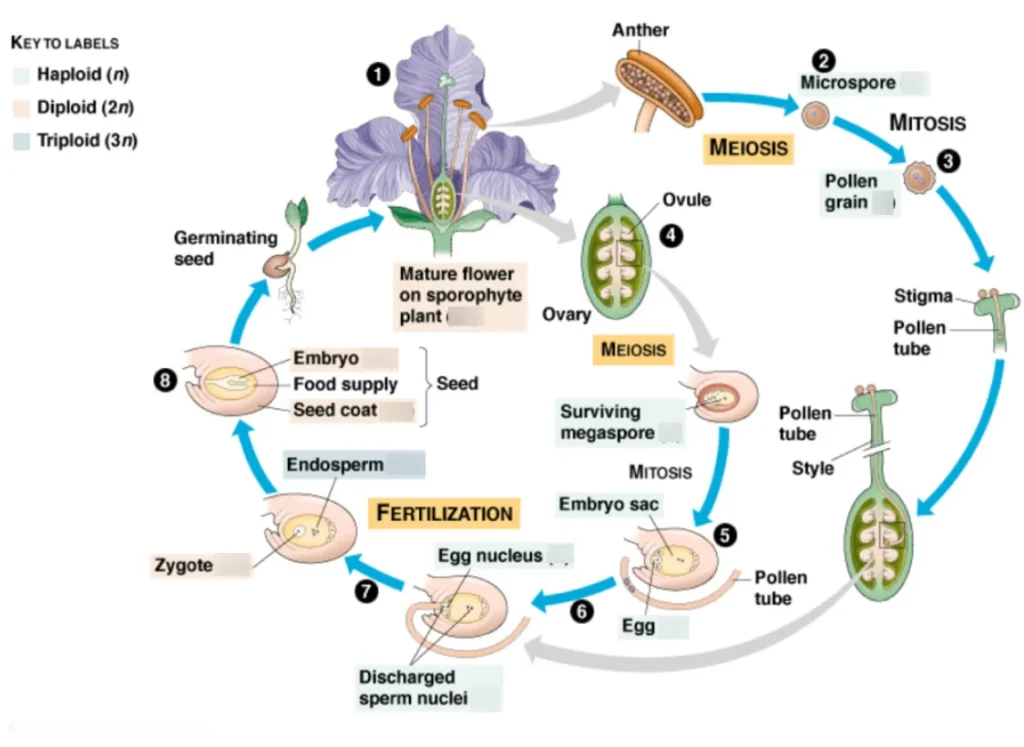
The angiosperm life cycle is mainly dominated by the sporophyte stage, meaning the visible plant body is the main form. The smaller gametophyte stage exists inside the flower as pollen grains and the embryo sac. A key feature of angiosperms is double fertilization, in which one sperm forms the embryo and the other forms the nutrient-rich endosperm.
Quick Answers: Most Common Questions
Q: What is an angiosperm?
A: An angiosperm is a flowering plant that produces seeds enclosed inside an ovary, which often becomes a fruit.
Q: What are the main stages in the angiosperm life cycle?
A: The main stages are seed, germination, growth or mature sporophyte, flowering, pollination, fertilization, fruit, and seed formation.
Q: What is the biggest difference between angiosperms and gymnosperms?
A: In angiosperm vs gymnosperm comparison, angiosperms have flowers and enclosed seeds, while gymnosperms usually have cones and exposed seeds.
Quick Life Cycle Table
| Life Cycle Step | What Happens | Easy Example |
| Seed | A protected embryo remains inside a seed, which stores food. | Bean seed |
| Germination | The seed absorbs water, the root emerges, and then the shoot grows upward. | Sprouting bean |
| Young Plant | Leaves, stems, and roots develop through photosynthesis. | Seedling |
| Mature Plant | The visible sporophyte plant becomes strong enough to reproduce. | Adult sunflower |
| Flowering | Flowers produce pollen and ovules. | Rose flower |
| Pollination | Pollen reaches the stigma by wind, water, insects, birds, or animals. | Be on a flower |
| Double Fertilization | One sperm forms the embryo; the other forms the endosperm. | Lily or corn |
| Fruit and Seed | Ovary becomes fruit; ovule becomes seed. | Apple, tomato |
| Seed Dispersal | Wind, animals, water, gravity, or humans spread seeds. | Dandelion, mango |
Important Things That You Need To Know
To understand the life cycle of an angiosperm, it is helpful to connect several related terms. The first is the angiosperm definition: an angiosperm is a vascular plant with flowers that produces seeds inside an ovary. This ovary can later become a fruit, which helps protect and disperse the seed.
Another important phrase is what is an angiosperm. In simple words, it is any flowering plant, from tiny herbs to huge fruit trees. Rice, wheat, orchids, roses, pumpkins, cucumbers, bananas, and oaks are all angiosperms.
The comparison between angiosperms and gymnosperms is also important. Angiosperms produce flowers and fruits, while gymnosperms usually produce cones and exposed seeds. In gymnosperm vs angiosperm comparison, gymnosperms are often wind-pollinated and include pines, cycads, ginkgo, and firs. Angiosperms use many pollination methods, including insects, birds, bats, wind, and water.
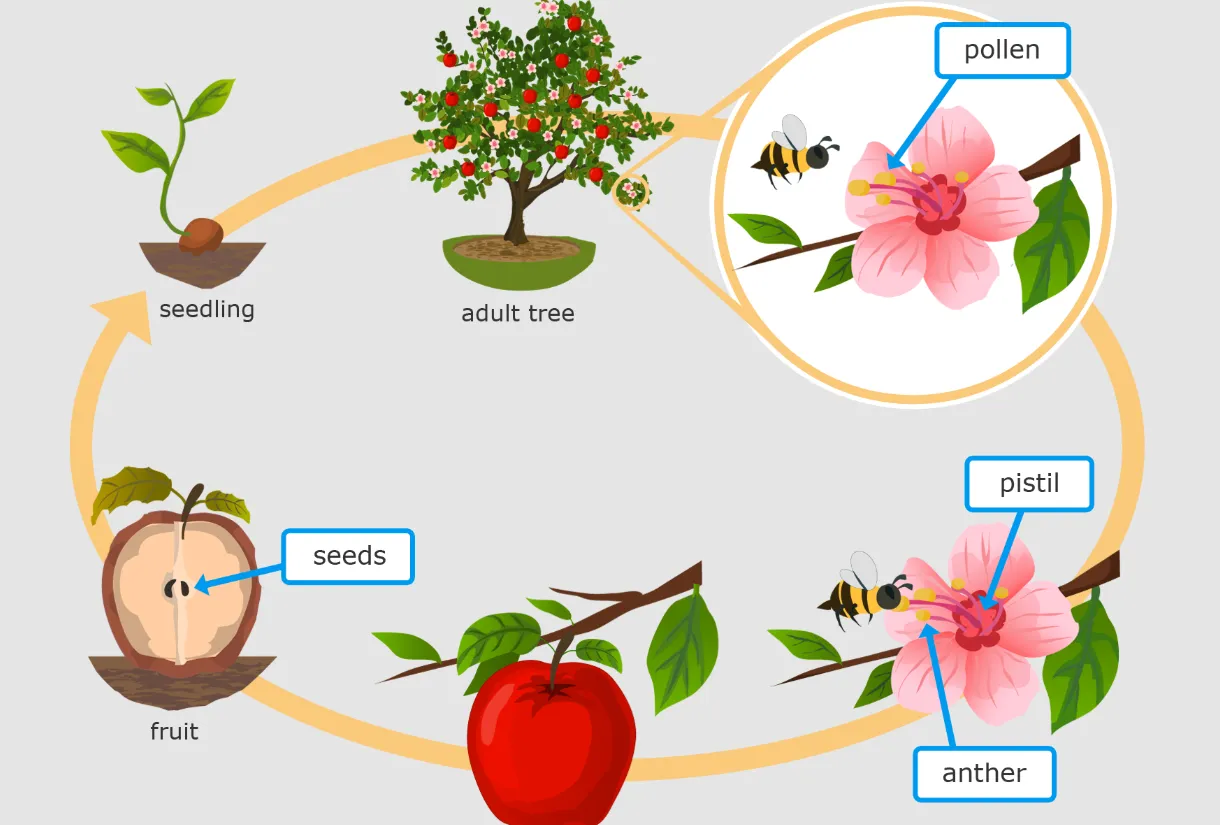
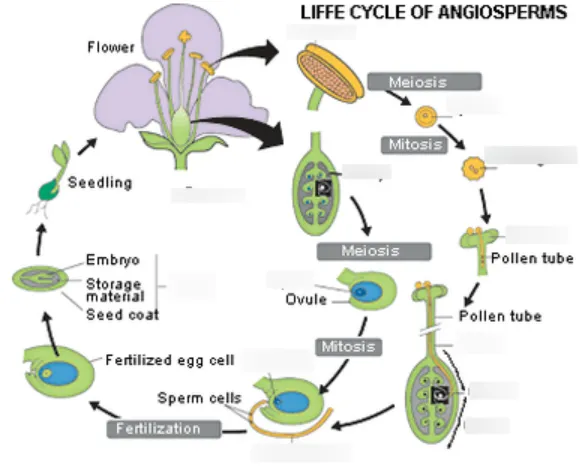
The angiosperm life cycle diagram usually shows alternation between the large sporophyte plant and the tiny gametophytes within the flower. The male gametophyte is the pollen grain. The female gametophyte is the embryo sac inside the ovule.
The angiosperm life cycle is successful because flowers attract pollinators, fruits protect seeds, and seeds can survive difficult conditions until the environment is suitable for germination.
The History Of Their Scientific Naming, Evolution, and Their Origin
Scientific Naming of Angiosperms
The word angiosperm comes from Greek roots meaning “vessel” and “seed.” This name fits because angiosperm seeds develop inside a protective structure. Historically, the term Angiospermae was used for plants with enclosed seeds, and later botanical work gave the term its modern meaning.
Today, angiosperms are often called flowering plants. In classification, they are treated as a major plant lineage rather than just a simple garden category.
Evolutionary Origin Of Angiosperms
The origin of angiosperms has fascinated scientists for generations. Charles Darwin famously described the rapid rise of flowering plants as an “abominable mystery” because they appeared suddenly and diversified quickly in the fossil record. The University of California Museum of Paleontology notes that angiosperms appear rather suddenly in the fossil record, and their origin remains a major evolutionary question.
Rise During The Cretaceous Period
Strong fossil evidence places the major rise of angiosperms in the Cretaceous Period, when dinosaurs still lived. Their success likely came from flowers, fruits, efficient vascular tissue, close relationships with pollinators, and flexible seed dispersal.
Modern Classification
Modern angiosperm classification is strongly influenced by DNA evidence. The Angiosperm Phylogeny Group system uses molecular relationships to classify flowering plants more accurately than older systems based mainly on visible traits.
Their Reproductive Process, Giving Birth, and Raising Their Children
Angiosperms Do Not Give Birth Like Animals
Angiosperms do not give birth or raise children in the sense that animals do. Instead, they produce offspring through seeds. Their “children” are embryos protected inside seeds, often surrounded by fruits.
This reproductive method is highly successful because seeds can stay dormant, travel long distances, and germinate when conditions become favorable.
Flower Formation
The reproductive process begins when a mature angiosperm forms flowers. A flower may contain male parts, female parts, or both. The stamen produces pollen, while the carpel contains ovules. Britannica explains that carpels enclose ovules, and after fertilization, the ovule becomes a seed while the carpel becomes a fruit.
Pollination
Pollination happens when pollen reaches the stigma of a flower. This may occur through wind, insects, birds, bats, water, or self-pollination. OpenStax explains that angiosperm fertilization begins when pollen is transferred to the stigma.
Fertilization And Embryo Development
After pollination, the pollen tube grows down toward the ovule. Two sperm cells travel through this tube. One fertilizes the egg, forming the zygote, which becomes the embryo. The second joins with polar nuclei to form the endosperm, which nourishes the developing embryo. This is called double fertilization, a signature feature of angiosperms.
Seed And Fruit Protection
Once fertilization is complete, the ovule becomes a seed, and the ovary becomes a fruit. The fruit protects the seed and helps it spread. Animals may eat fleshy fruits and later disperse the seeds, while dry fruits may split, float, stick to fur, or blow in the wind.
Stages of the Angiosperm Life Cycle
Stage 1: Seed Stage
The first stage of an angiosperm’s life cycle is the seed stage. A seed contains a young embryo, stored food, and a protective seed coat. The embryo usually has a tiny root, a tiny shoot, and one or two cotyledons.
Seeds are powerful survival structures. Some germinate quickly, while others remain dormant until temperature, moisture, oxygen, and light conditions are suitable. This dormancy helps angiosperms survive drought, cold, fire, or seasonal changes.
Stage 2: Germination Stage
Germination begins when the seed absorbs water. The seed coat softens, enzymes become active, and stored food is converted into energy.
The first structure to emerge is usually the radicle, or young root. It anchors the plant and begins absorbing water and minerals. After that, the shoot grows upward toward the light. When the first leaves open, the seedling begins making its own food through photosynthesis.
Stage 3: Vegetative Growth Stage
In the vegetative stage, the plant focuses on roots, stems, and leaves. The root system expands underground, while stems support leaves and transport water, minerals, and sugars.
Leaves capture sunlight and use photosynthesis to produce carbohydrates. OpenStax explains that photosynthesis uses sunlight, carbon dioxide, and water to produce energy-storing carbohydrates, while releasing oxygen as a by-product.
Stage 4: Reproductive Stage
The mature angiosperm enters the reproductive stage by producing flowers. Inside the flowers, pollen and ovules form. Pollination brings pollen to the stigma, fertilization produces the embryo and endosperm, and the ovary develops into fruit.
The cycle begins and ends when seeds disperse, land in a suitable habitat, and germinate into new angiosperm plants.
Their Main Diet, Food Sources, And Collection Process Explained
Angiosperms do not eat food like animals. Their main “diet” comes from sunlight, carbon dioxide, water, and mineral nutrients. Through photosynthesis, green angiosperms make sugars that fuel growth, flowering, fruiting, seed development, and storage.
Sunlight As The Main Energy Source
Most angiosperms use chlorophyll in their leaves to capture sunlight. This energy helps convert carbon dioxide and water into carbohydrates. These carbohydrates may be converted to glucose, sucrose, starch, cellulose, nectar, fruit sugars, or seed reserves.
Water And Minerals From Roots
Roots absorb water and dissolved minerals from the soil. Important plant macronutrients include carbon, hydrogen, oxygen, nitrogen, phosphorus, potassium, calcium, magnesium, and sulfur. OpenStax lists these as essential macronutrients required in larger amounts for plant growth.
Carbon Dioxide From Air
Leaves take in carbon dioxide through tiny pores called stomata. The plant uses carbon to build carbohydrates, proteins, oils, fibers, and other organic compounds.
Nutrient Collection Through Soil Life
Many angiosperms benefit from fungi and bacteria in their root zones. Mycorrhizal fungi can improve access to phosphorus, zinc, copper, and water. Nitrogen-fixing bacteria help some flowering plants, especially legumes, gain usable nitrogen.
Special Exceptions
Some angiosperms are unusual. Carnivorous plants such as Venus flytraps and pitcher plants still photosynthesize, but they trap insects to gain extra nutrients from poor soils. Parasitic angiosperms may steal water or sugars from host plants.
How Long Does An Angiosperm Live?
The lifespan of an angiosperm depends on the species, habitat, climate, disease pressure, grazing, human care, and reproductive strategy. There is no single lifespan for all angiosperms because this group includes tiny herbs, grasses, shrubs, vines, crops, and long-lived trees.
- Annual angiosperms complete their entire life cycle in one growing season. They germinate, grow, flower, make seeds, and die within months. Examples include many cereals, vegetables, and garden flowers.
- Biennial angiosperms usually live for two growing seasons. In the first season, they grow leaves, roots, and food-storage organs. In the second season, they flower, produce seeds, and die. Oregon State University Extension explains that biennials need all or part of two years to complete their life cycle.
- Perennial angiosperms live for more than two years. Some herbaceous perennials die back above ground during harsh seasons but regrow from roots, bulbs, tubers, rhizomes, or crowns.
- Woody angiosperms such as oaks, maples, mangoes, apples, and magnolias can live for decades or centuries when conditions are favorable.
- Short-lived herbs may live only a few weeks or months, especially in deserts or seasonal grasslands where plants must complete reproduction quickly after rain.
- Crop angiosperms are often harvested before they die naturally. Lettuce, spinach, rice, wheat, and tomato plants may be removed after harvest, even though some could live longer under different conditions.
- Environmental stress can shorten lifespan. Drought, flooding, fire, frost, salinity, pests, disease, competition, and habitat destruction can kill plants before they reproduce.
- Dormancy increases survival. Many angiosperm seeds survive unfavorable periods and restart the life cycle when conditions improve.
- Human cultivation can extend life in some species. Proper watering, pruning, soil care, pest control, and climate protection may help cultivated plants live longer than wild individuals.
In simple terms, an angiosperm can live from a few weeks to hundreds of years, depending on whether it is an annual herb, biennial plant, perennial herb, shrub, vine, or tree.
Angiosperm Lifespan in the Wild vs. in Captivity
Lifespan In The Wild
In the wild, angiosperms live under natural pressure. They must compete for sunlight, water, space, pollinators, and soil nutrients. They also face herbivores, fungi, bacteria, drought, storms, fire, floods, and human disturbance.
Wild annuals may live only one season. Wild perennials may return year after year if their roots, bulbs, crowns, or woody stems survive. Wild trees may live for decades or centuries when they grow in stable habitats.
Lifespan In Cultivation Or Captivity
Plants are not kept in captivity like animals, but they can live under cultivation, in gardens, greenhouses, farms, botanical gardens, seed banks, and conservation collections.
Cultivated angiosperms may live longer when protected from drought, pests, poor soil, and extreme temperatures. Fruit trees, orchids, roses, and rare plants often survive better with skilled care.
However, cultivation can also shorten life. Many crops are harvested early, heavily pruned, or grown for a single production cycle.
Why The Difference Matters
Wild plants support ecosystems directly, while cultivated plants support food, medicine, research, beauty, and conservation. Both are important, but wild populations are essential for genetic diversity and long-term survival.
Importance of Angiosperms in This Ecosystem
Foundation Of Food Chains
Angiosperms are primary producers. They capture sunlight and turn it into plant biomass, which feeds insects, birds, mammals, reptiles, fungi, bacteria, and humans.
Many food chains begin with flowering plants. Without angiosperms, ecosystems would lose fruits, seeds, nectar, leaves, roots, grains, and plant-based shelter.
Support For Pollinators
Angiosperms provide nectar and pollen for bees, butterflies, flies, beetles, moths, birds, and bats. FAO reports that over 80% of all flowering plant species are pollinated by animals, mostly insects, and pollination affects about 35% of global crop production.
Human Food Security
Most staple foods are angiosperms, including rice, wheat, maize, potatoes, beans, fruits, vegetables, oils, spices, nuts, and many medicines. Their life cycle directly supports agriculture and human survival.
Habitat Creation
Angiosperm forests, grasslands, wetlands, and shrublands create shelter and nesting spaces. Trees regulate temperature, stabilize soil, store carbon, and influence rainfall patterns.
Biodiversity Protection
Because angiosperms interact with pollinators, seed dispersers, soil organisms, and herbivores, protecting them also protects wider biodiversity. IPBES reports that nearly 90% of wild flowering plants depend at least partly on animal pollination.
What To Do To Protect Them In Nature And Save The System For The Future
Protect Natural Habitats
- Conserve forests, wetlands, grasslands, riverbanks, and native meadows.
- Avoid unnecessary land clearing.
- Support protected areas and community conservation zones.
Reduce Harmful Chemical Use
- Limit pesticide and herbicide use, especially during flowering.
- Choose targeted, low-impact pest control methods.
- Avoid chemicals that harm pollinators and soil organisms.
Plant Native Angiosperms
- Grow native flowering plants in gardens, farms, schools, parks, and roadsides.
- Native plants support local bees, butterflies, birds, and seed dispersers better than many ornamental exotics.
Save Seeds And Genetic Diversity
- Support seed banks, botanical gardens, and local seed-saving programs.
- Grow diverse crop varieties instead of relying on only one type.
- Protect wild relatives of crops, as they may harbor genes for drought, disease, or climate resistance.
Fight Climate Change And Habitat Loss
- Reduce waste, restore degraded land, plant trees wisely, and protect old ecosystems.
- Kew-linked reporting on the State of the World’s Plants and Fungi 2023 highlights that around 45% of known flowering plant species could be threatened with extinction, making conservation urgent.
Fun & Interesting Facts About Angiosperms
- Angiosperms are flowering plants, but not all flowers are large or colorful. Grass flowers are tiny and often overlooked.
- The visible plant body is the sporophyte, while the gametophyte is tiny and hidden inside the reproductive structures.
- Double fertilization is one of the most important features of the angiosperm life cycle.
- Fruits are mature ovaries. Apples, tomatoes, cucumbers, pumpkins, bananas, and grains are all linked to flower reproduction.
- Some angiosperms use fragrance, color, nectar, heat, or even mimicry to attract pollinators.
- Orchids are among the most diverse angiosperm families and often have highly specialized pollination strategies.
- Wind-pollinated angiosperms, such as grasses, usually have small flowers without bright petals.
- Many human foods come from angiosperm seeds, including rice, wheat, corn, beans, peas, almonds, and coffee.
- Some angiosperms are aquatic, such as water lilies and seagrasses.
- Some flowering plants can reproduce both sexually through seeds and asexually through runners, bulbs, tubers, rhizomes, or cuttings.
Frequently Asked Questions About the Life Cycle of Angiosperms
Q: What is the life cycle of an angiosperm?
A: The life cycle of an angiosperm is the process by which flowering plants grow from seed, germinate, become mature plants, produce flowers, undergo pollination and fertilization, form fruits and seeds, and start the cycle again.
Q: Why is double fertilization important in angiosperms?
A: Double fertilization forms both the embryo and the endosperm. The embryo becomes the new plant, while the endosperm provides nourishment during seed development.
Q: What is the difference between angiosperms and gymnosperms?
A: In angiosperm vs gymnosperm comparison, angiosperms produce flowers and enclosed seeds inside fruits. Gymnosperms produce exposed seeds, usually on cones, and do not form true fruits.
Q: Do all angiosperms need pollinators?
A: No. Many angiosperms depend on animals, but others use wind, water, or self-pollination. However, animal pollination is extremely important for wild flowering plants and many crops.
Q: What does an angiosperm life cycle diagram show?
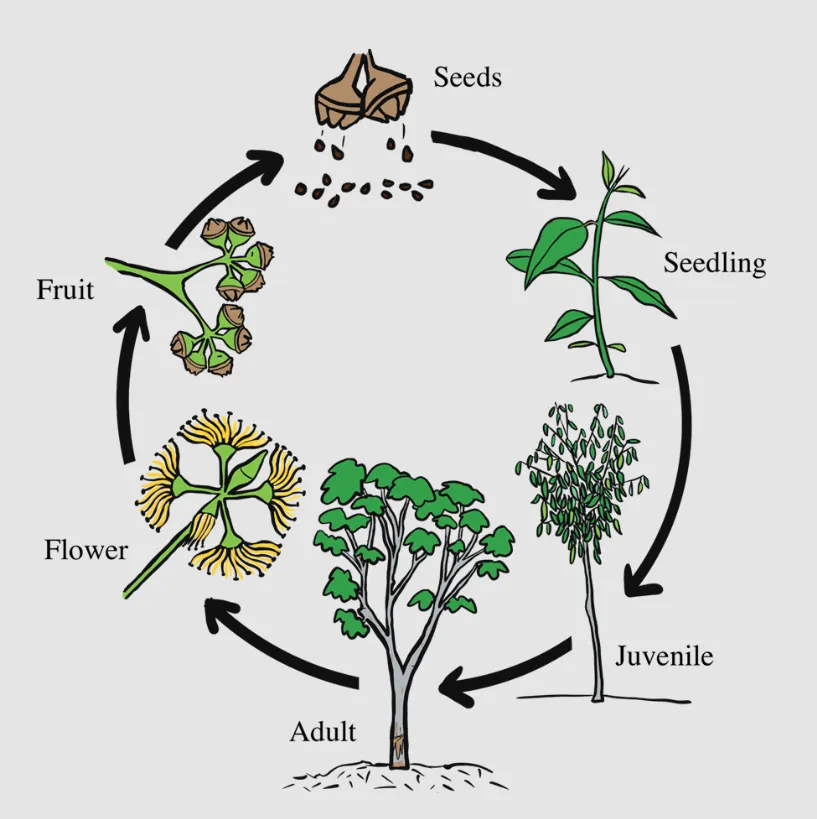
A: An angiosperm life cycle diagram usually shows the seed, germination, mature sporophyte plant, flower, pollen, ovule, pollination, double fertilization, fruit formation, seed dispersal, and return to germination.
Final Word
The angiosperm life cycle rm is one of the most successful biological systems on Earth. From a tiny seed to a flowering plant, and from pollination to fruit and seed formation, every step is designed for survival, reproduction, and adaptation. Angiosperms dominate modern plant life because they combine flowers, enclosed seeds, fruits, efficient nutrient movement, and strong relationships with pollinators and seed dispersers.
Understanding what an angiosperm is helps us understand food, forests, gardens, agriculture, biodiversity, and ecosystem health. These plants give us grains, fruits, vegetables, fibers, medicines, oxygen, shade, beauty, and wildlife habitat.
Protecting angiosperms means protecting pollinators, soil, water, forests, food systems, and future generations. Their life cycle is not just a plant science topic. It is a foundation of life on Earth.
Also Read: Life Cycle Lightning Bug
About the Author